The Unleashed Body-Mind Connection
- YongJia
- Aug 12, 2022
- 3 min read
Updated: Aug 25, 2022
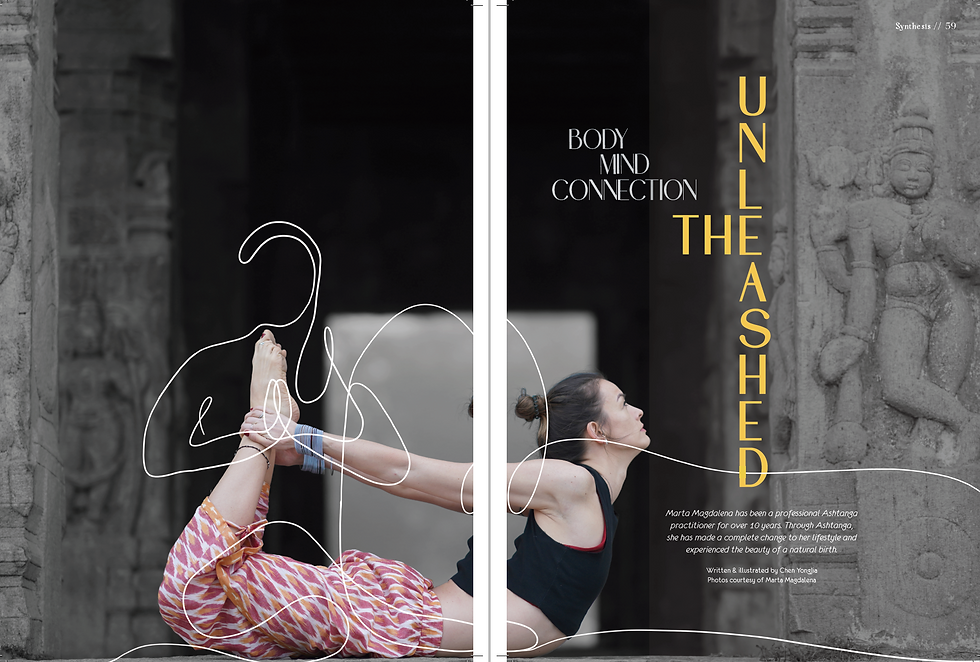
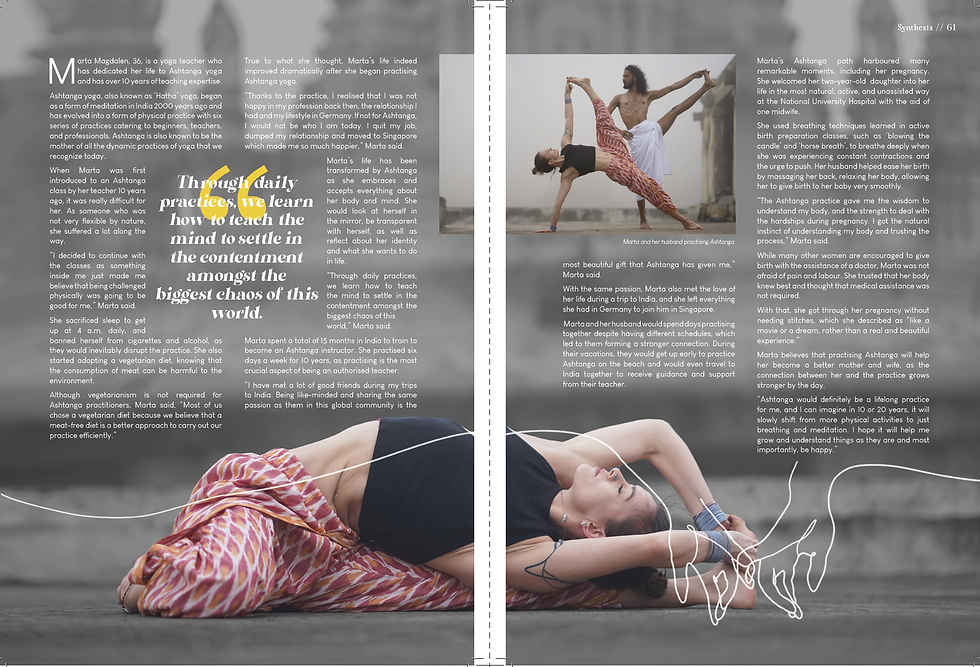
Marta Magdalen, 36, is a yoga teacher who has dedicated her life to Ashtanga yoga and has over 10 years of teaching expertise.
Ashtanga yoga, also known as ‘Hatha’ yoga, began as a form of meditation in India 2000 years ago and has evolved into a form of physical practice with six series of practices catering to beginners, teachers, and professionals. Ashtanga is also known to be the mother of all the dynamic practices of yoga that we recognize today.
When Marta was first introduced to an Ashtanga class by her teacher 10 years ago, it was really difficult for her. As someone who was not very fIexible by nature, she suffered a lot along the way.
“I decided to continue with the classes as something inside me just made me believe that being challenged physically was going to be good for me,” Marta said.
She sacrificed sleep to get up at 4 a.m. daily, and banned herself from cigarettes and alcohol, as they would inevitably disrupt the practice. She also started adopting a vegetarian diet, knowing that the consumption of meat can be harmful to the environment.
Although vegetarianism is not required for Ashtanga practitioners, Marta said, “Most of us chose a vegetarian diet because we believe that a meat-free diet is a better approach to carry out our practice efficiently.”
True to what she thought, Marta’s life indeed improved dramatically after she began practising Ashtanga yoga.
“Thanks to the practice, I realised that I was not happy in my profession back then, the relationship I had and my lifestyle in Germany. If not for Ashtanga, I would not be who I am today. I quit my job, dumped my relationship and moved to Singapore which made me so much happier,” Marta said.
Marta’s life has been transformed by Ashtanga as she embraces and accepts everything about her body and mind. She would look at herself in the mirror, be transparent with herself, as well as refIect about her identity and what she wants to do in life.
“Through daily practices, we learn how to teach the mind to settle in the contentment amongst the biggest chaos of this world,” Marta said.
Marta spent a total of 15 months in India to train to become an Ashtanga instructor. She practised six days a week for 10 years, as practising is the most crucial aspect of being an authorised teacher.
“I have met a lot of good friends during my trips to India. Being like-minded and sharing the same passion as them in this global community is the most beautiful gift that Ashtanga has given me,” Marta said.
With the same passion, Marta also met the love of her life during a trip to India, and she left everything she had in Germany to join him in Singapore.
Marta and her husband would spend days practising together despite having different schedules, which led to them forming a stronger connection. During their vacations, they would get up early to practice Ashtanga on the beach and would even travel to India together to receive guidance and support from their teacher.
Marta’s Ashtanga path harboured many remarkable moments, including her pregnancy. She welcomed her two-year-old daughter into her life in the most natural, active, and unassisted way at the National University Hospital with the aid of one midwife.
She used breathing techniques learned in active birth preparation classes, such as ‘blowing the candle’ and ‘horse breath’, to breathe deeply when she was experiencing constant contractions and the urge to push. Her husband helped ease her birth by massaging her back, relaxing her body, allowing her to give birth to her baby very smoothly.
“The Ashtanga practice gave me the wisdom to understand my body, and the strength to deal with the hardships during pregnancy. I got the natural instinct of understanding my body and trusting the process,” Marta said.
While many other women are encouraged to give birth with the assistance of a doctor, Marta was not afraid of pain and labour. She trusted that her body knew best and thought that medical assistance was not required.
With that, she got through her pregnancy without needing stitches, which she described as “like a movie or a dream, rather than a real and beautiful experience.”
Marta believes that practising Ashtanga will help her become a better mother and wife, as the connection between her and the practice grows stronger by the day.
“Ashtanga would definitely be a lifelong practice for me, and I can imagine in 10 or 20 years, it will slowly shift from more physical activities to just breathing and meditation. I hope it will help me grow and understand things as they are and most importantly, be happy.”

Comments