Taste Of The World
- YongJia
- Aug 12, 2022
- 3 min read
Updated: Aug 25, 2022
Do you remember eating your favourite dish as a child? When we think of our hometown, we all have that one dish in mind.
Food can be nostalgic and provide a strong link to our family, country, and cultural heritage. Food also serves as a bridge for immigrants to find their place in a new society.
Our ethnicity and beliefs are incorporated into food production, serving as a mode of communication with others. Food is more than just a part of culture; it defines culture more than we realise.
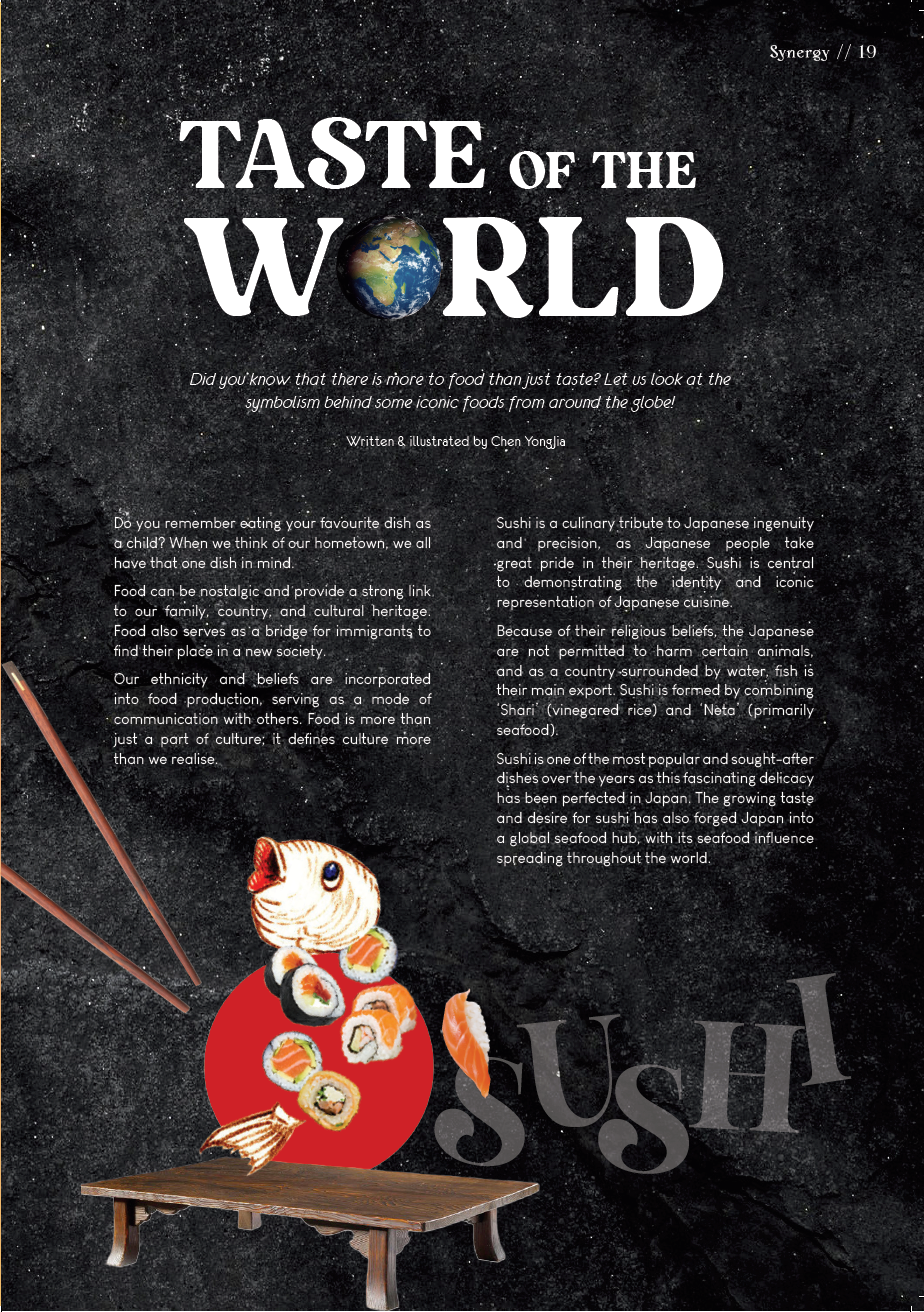
Sushi is a culinary tribute to Japanese ingenuity and precision, as Japanese people take great pride in their heritage. Sushi is central to demonstrating the identity and iconic representation of Japanese cuisine.
Because of their religious beliefs, the Japanese are not permitted to harm certain animals, and as a country surrounded by water, fish is their main export. Sushi is formed by combining ‘Shari’ (vinegared rice) and ‘Neta’ (primarily seafood).
Sushi is one of the most popular and sought-after dishes over the years as this fascinating delicacy has been perfected in Japan. The growing taste and desire for sushi has also forged Japan into a global seafood hub, with its seafood infIuence spreading throughout the world.
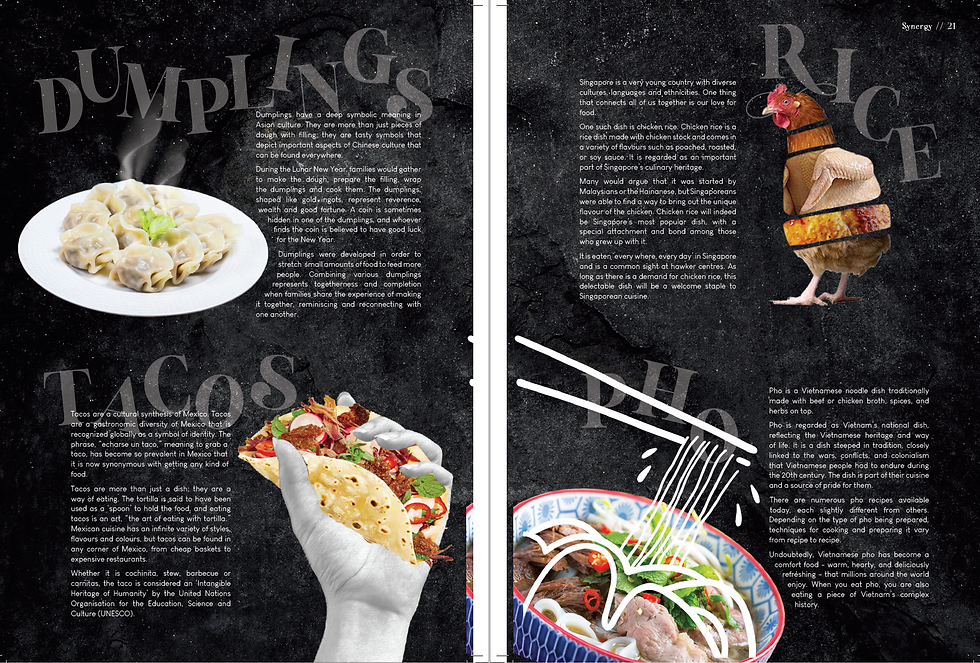
Dumplings have a deep symbolic meaning in Asian culture. They are more than just pieces of dough with filling; they are tasty symbols that depict important aspects of Chinese culture that can be found everywhere.
During the Lunar New Year, families would gather to make the dough, prepare the filling, wrap the dumplings and cook them. The dumplings, shaped like gold ingots, represent reverence, wealth and good fortune. A coin is sometimes hidden in one of the dumplings, and whoever finds the coin is believed to have good luck for the New Year.
Dumplings were developed in order to stretch small amounts of food to feed more people. Combining various dumplings represents togetherness and completion when families share the experience of making it together, reminiscing and reconnecting with one another.
Tacos are a cultural synthesis of Mexico. Tacos are a gastronomic diversity of Mexico that is recognized globally as a symbol of identity. The phrase, “echarse un taco,” meaning to grab a taco, has become so prevalent in Mexico that it is now synonymous with getting any kind of food.
Tacos are more than just a dish; they are a way of eating. The tortilla is said to have been used as a ‘spoon’ to hold the food, and eating tacos is an art, “the art of eating with tortilla.” Mexican cuisine has an infinite variety of styles, fIavours and colours, but tacos can be found in any corner of Mexico, from cheap baskets to expensive restaurants.
Whether it is cochinita, stew, barbecue or carnitas, the taco is considered an ‘Intangible Heritage of Humanity’ by the United Nations Organisation for the Education, Science and Culture (UNESCO).
Singapore is a very young country with diverse cultures, languages and ethnicities. One thing that connects all of us together is our love for food.
One such dish is chicken rice. Chicken rice is a rice dish made with chicken stock and comes in a variety of fIavours such as poached, roasted, or soy sauce. It is regarded as an important part of Singapore’s culinary heritage.
Many would argue that it was started by Malaysians or the Hainanese, but Singaporeans were able to find a way to bring out the unique fIavour of the chicken. Chicken rice will indeed be Singapore’s most popular dish, with a special attachment and bond among those who grew up with it.
It is eaten ‘every where, every day’ in Singapore and is a common sight at hawker centres. As long as there is a demand for chicken rice, this delectable dish will be a welcome staple to Singaporean cuisine.
Pho is a Vietnamese noodle dish traditionally made with beef or chicken broth, spices, and herbs on top.
Pho is regarded as Vietnam’s national dish, refIecting the Vietnamese heritage and way of life. It is a dish steeped in tradition, closely linked to the wars, confIicts, and colonialism that Vietnamese people had to endure during the 20th century. The dish is part of their cuisine and a source of pride for them.
There are numerous pho recipes available today, each slightly different from others. Depending on the type of pho being prepared, techniques for cooking and preparing it vary from recipe to recipe.
Undoubtedly, Vietnamese pho has become a comfort food - warm, hearty, and deliciously refreshing - that millions around the world enjoy. When you eat pho, you are also eating a piece of Vietnam’s complex history.
Comments