The Symbolisation Of Colours
- YongJia
- Aug 12, 2022
- 2 min read
Updated: Aug 25, 2022
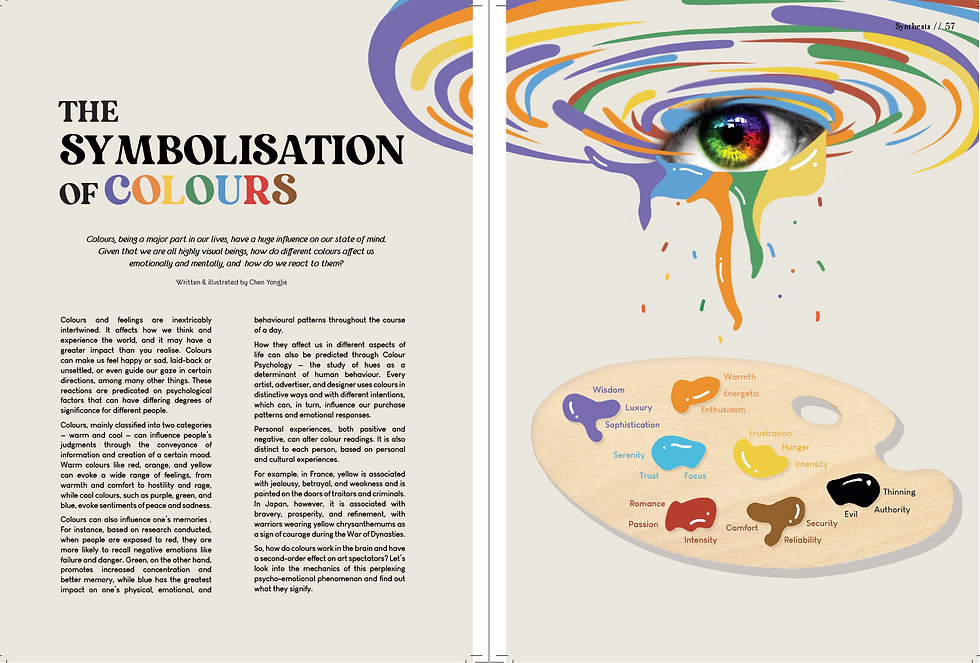
Colours and feelings are inextricably intertwined. It affects how we think and experience the world, and it may have a greater impact than you realise. Colours can make us feel happy or sad, laid-back or unsettled, or even guide our gaze in certain directions, among many other things. These reactions are predicated on psychological factors that can have differing degrees of significance for different people.
Colours, mainly classified into two categories — warm and cool — can infIuence people’s judgments through the conveyance of information and creation of a certain mood. Warm colours like red, orange, and yellow can evoke a wide range of feelings, from warmth and comfort to hostility and rage, while cool colours, such as purple, green, and blue, evoke sentiments of peace and sadness.
Colours can also infIuence one’s memories . For instance, based on research conducted, when people are exposed to red, they are more likely to recall negative emotions like failure and danger. Green, on the other hand, promotes increased concentration and better memory, while blue has the greatest impact on one’s physical, emotional, and behavioural patterns throughout the course of a day.
How they affect us in different aspects of life can also be predicted through Colour Psychology — the study of hues as a determinant of human behaviour. Every artist, advertiser, and designer uses colours in distinctive ways and with different intentions, which can, in turn, infIuence our purchase patterns and emotional responses.
Personal experiences, both positive and negative, can alter colour readings. It is also distinct to each person, based on personal and cultural experiences.
For example, in France, yellow is associated with jealousy, betrayal, and weakness and is painted on the doors of traitors and criminals. In Japan, however, it is associated with bravery, prosperity, and refinement, with warriors wearing yellow chrysanthemums as a sign of courage during the War of Dynasties.
So, how do colours work in the brain and have a second-order effect on art spectators? Let’s look into the mechanics of this perplexing psycho-emotional phenomenon and find out what they signify.

Comments